GE vs Midea Window Air Conditioners: Which Brand Fits You?
As an Amazon Associate we earn from qualifying purchases. Links on this page are affiliate links.
When you compare a GE vs midea window air conditioner, you are looking at two distinct approaches to cooling. Both units are certified refurbished, meaning they have been tested to work like new. The main difference lies in their power and control. The GE model offers stronger cooling with inverter technology and smart features. The Midea option is a simpler, mechanical unit designed for smaller spaces.
Key differences
| Aspect | GE Profile 8,000 BTU Inverter Window AC | Midea 5,000 BTU Mechanical Window AC |
|---|---|---|
| Cooling Capacity | 8,000 BTU | 5,000 BTU |
| Control Type | App, voice, remote | Mechanical |
| Coverage Area | Medium rooms | 150 Sq ft |
| Noise Level | 43 dB | not listed |
| Energy Efficiency | 15.0 CEER | not listed |
Which one should you choose?
Choose GE Profile 8,000 BTU Inverter Window AC if
- You need to cool a medium-sized room with stronger airflow
- You want to control the unit via a smartphone app or voice commands
- You prioritize energy efficiency and quiet operation for nighttime use
Choose Midea 5,000 BTU Mechanical Window AC if
- You only need to cool a small space up to 150 square feet
- You prefer simple, direct mechanical controls without apps or remotes
- You want a lighter, more compact unit that is easier to handle
Verdict: The GE Profile is the better choice if you need serious cooling power and smart convenience for a larger room. The Midea is a practical, no-fuss solution for smaller spaces where simple controls are preferred. Your decision depends on whether you need advanced features or just basic cooling.
GE vs Midea: Spec Comparison
Cooling capacity
The GE Profile offers 8,000 BTU of cooling power. This higher output allows it to handle larger spaces more effectively than the Midea unit. Midea provides 5,000 BTU, which is sufficient for smaller areas. You should choose the GE model if your room exceeds the Midea's recommended size. The Midea unit is rated for 150 square feet. The GE data does not list a specific square footage, but the higher BTU count suggests it covers more area. This makes the GE unit more versatile for medium-sized rooms.
Control type
Control methods differ significantly between these two brands. The GE Profile includes a remote control and supports app integration via the SmartHQ app. It also works with voice assistants like Amazon Alexa and Google Assistant. Midea uses mechanical controls only. You will adjust settings directly on the unit with physical dials or buttons. The GE option provides greater convenience for remote operation and scheduling. The Midea unit requires you to be near the device to change settings. If you prefer smart home integration, the GE model is the clear choice.
Noise level
Noise performance is a key spec for bedroom use. The GE Profile operates at 43 dB, which is quite quiet for a window unit. The Midea data does not list a specific decibel rating. We cannot compare exact noise levels without Midea's published spec. However, GE’s inverter compressor often runs smoother and quieter than mechanical units. The GE unit also features a dedicated quiet mode for nighttime use. You should check the Midea manual for noise details if silence is your priority. Based on available data, GE has the advantage in documented quietness.
Energy efficiency
Efficiency impacts your long-term electricity usage. The GE Profile has a CEER rating of 15.0. This is certified as 37% more efficient than the DOE minimum for comparable capacity. The Midea unit does not list a CEER or EER rating in the provided data. Without this number, you cannot verify its efficiency relative to modern standards. The GE inverter compressor also adjusts speed to maintain temperature, which saves energy. The Midea mechanical unit likely runs at full power until the target temperature is reached. GE is the better choice for energy-conscious buyers.
Physical dimensions
Size matters for fitting your window frame. The Midea unit is narrower, measuring 16 inches wide. The GE Profile is wider at 18.5 inches. Midea is also shorter, standing 12.1 inches tall compared to GE’s 13.4 inches. GE is deeper at 18.9 inches versus Midea’s 13.2 inches. Midea weighs 33.1 pounds, making it lighter and easier to handle than the 44.1-pound GE unit. You must ensure your window sill can support the weight. The Midea fits windows 23 to 36 inches wide. Check your window width against both units before purchasing.
Which GE or Midea AC suits you
You want smart features and quiet operation
The GE Profile includes app and voice control via SmartHQ and Alexa. It also features an inverter compressor for efficiency and operates at just 43 dB. This makes it ideal for bedrooms or living areas where low noise and remote scheduling matter most to your daily comfort.
You need a simple, compact unit for small rooms
The Midea model offers 5,000 BTU of cooling, suitable for spaces up to 150 square feet. It uses mechanical controls for straightforward operation without needing an app. Its smaller footprint and lighter weight make it an easy choice for tight window fits or smaller bedrooms.
You prefer energy efficiency and higher cooling power
With 8,000 BTU and a 15.0 CEER rating, this unit cools larger rooms more effectively while using less energy than standard models. The inverter technology adjusts speed to maintain temperature, reducing power consumption. This combination provides stronger performance and better long-term efficiency for medium-sized spaces.
The products compared

GE Profile 8,000 BTU Inverter Window AC
Best for: smart home integration and quiet cooling
- Cooling Capacity
- 8,000BTU
- Noise Level
- 43 dB
- Control Type
- App, voice control, remote control
- Compressor Type
- Inverter
- CEER Rating
- 15.0
- Dimensions
- 18.9 × 18.5 × 13.4 inches
View on Amazon: GE Profile 8,000 BTU Inverter Window AC Affiliate link
This GE Profile unit delivers 8,000 BTU of cooling for medium rooms. Its inverter compressor and 15.0 CEER rating provide high energy efficiency. The design operates quietly at 43 dB. You can control it via the SmartHQ app, voice assistants, or the included remote. It is a renewed model with a 90-day warranty, making it a practical option for those seeking smart features and quiet performance.
Pros
- 15.0 CEER rating for high energy efficiency
- Inverter compressor technology
- Ultra-quiet operation at 43 dB
- SmartHQ app and voice control compatibility
Cons
- Renewed condition with only a 90-day warranty
- 8,000 BTU capacity limits use to smaller rooms
- Heavier at 44.1 pounds than basic mechanical units
Good fit if
- You want app control and voice assistant integration
- You need a quiet unit for bedrooms or living spaces
- You are looking for energy-efficient cooling with an inverter compressor
Skip if
- You require a brand-new unit with a full manufacturer warranty
- You need cooling power for large rooms above 150 sq ft
- You prefer a simple mechanical interface without smart features
Verdict: GE Profile 8,000 BTU Inverter AC suits buyers who prioritize smart connectivity and quiet operation in a medium-sized room. Its inverter technology and app control make it ideal for tech-savvy users seeking efficiency.
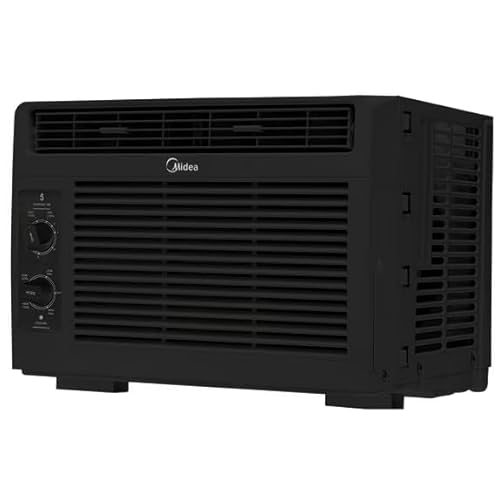
Midea 5,000 BTU Mechanical Window AC
Best for: Small rooms under 150 sq ft
- Cooling Capacity
- 5,000 BTU
- Coverage Area
- 150 Sq ft
- Control Type
- Mechanical
- Dimensions
- 13.2 × 16 × 12.1 inches
- Weight
- 33.1 pounds
View on Amazon: Midea 5,000 BTU Mechanical Window AC Affiliate link
This Midea unit offers 5,000 BTU of cooling for rooms up to 150 square feet. It features mechanical controls with two fan speeds and seven temperature settings. The black design fits windows 23 to 36 inches wide. It is a straightforward option for small spaces where simple operation is preferred over smart features.
Pros
- 5,000 BTU cooling capacity
- Covers up to 150 square feet
- Seven temperature settings
- Two fan speeds
Cons
- Mechanical controls only
- No remote control listed
- Lower capacity than 8,000 BTU models
Good fit if
- You need cooling for a small room under 150 sq ft
- You prefer simple mechanical dials over digital interfaces
- You have a window width between 23 and 36 inches
Skip if
- You require remote control operation
- You need to cool a room larger than 150 square feet
- You want smart home integration
Verdict: Midea 5,000 BTU Window AC is a basic cooling solution for small rooms. It suits buyers who value straightforward mechanical operation and do not need advanced features or higher power.
Specifications side by side
| Spec | GE Profile 8,000 BTU Inverter Window AC | Midea 5,000 BTU Mechanical Window AC |
|---|---|---|
| Cooling Capacity | 8,000BTU | 5,000 BTU |
| Coverage Area | not stated | 150 Sq ft |
| Noise Level | 43 dB | not stated |
| Control Type | App, voice control, remote control | Mechanical |
| Compressor Type | Inverter | not stated |
| CEER Rating | 15.0 | not stated |
| Features | Inverter | not stated |
| Dimensions | 18.9 × 18.5 × 13.4 inches | 13.2 × 16 × 12.1 inches |
| Weight | 44.1 pounds | 33.1 pounds |
| Color | White | Black |
| Model | CRTGEPWDV08WWFRB | RMW05MWB |
| Size | not stated | 5,000 BTU |
Frequently asked questions
Is GE or Midea better for small bedrooms?
Midea is the better choice for small bedrooms. Its 5,000 BTU capacity covers up to 150 square feet. The unit measures 16 inches wide and weighs 33.1 pounds. This compact size fits tighter window frames. GE’s 8,000 BTU model is larger and heavier, making it less suitable for tight spaces.
Does GE have smart home integration?
Yes, the GE Profile model supports smart home integration. You can control it via an app and voice commands through Alexa. It uses inverter technology for efficient cooling. Midea offers mechanical controls only, so you must adjust settings manually on the unit itself.
Which window AC is quieter, GE or Midea?
The GE Profile operates quietly at 43 dB. Its inverter compressor helps reduce noise during cooling cycles. The Midea unit does not list a specific decibel rating in its specifications. If quiet operation is a priority, the GE model provides verified low noise performance.
How do the dimensions compare between GE and Midea?
The GE Profile is larger in all dimensions. It measures 18.5 inches wide, 13.4 inches high, and 18.9 inches long. The Midea unit is smaller, measuring 16 inches wide, 12.1 inches high, and 13.2 inches long. Check your window frame size before purchasing either model.
Can I use these units in large rooms?
Only the GE Profile is suitable for larger rooms. It provides 8,000 BTU of cooling power. The Midea unit is rated for spaces up to 150 square feet. Using the Midea in a larger area may result in insufficient cooling and longer run times.
What control types are available for these brands?
GE offers advanced digital controls with app and voice support. You can adjust settings remotely using the SmartHQ app. Midea uses mechanical controls, which are simple and direct. You must interact with the unit physically to change temperature or fan speed.
Which brand is heavier and harder to install?
The GE Profile is heavier at 44.1 pounds. Its larger size and weight may require two people for installation. The Midea unit weighs 33.1 pounds. Its lighter build makes it easier to lift into place. Consider your physical ability to handle the weight.