Hisense or Midea? Window Air Conditioners Compared in 2026
As an Amazon Associate we earn from qualifying purchases. Links on this page are affiliate links.
When you compare the hisense vs midea window air conditioner options, you see two distinct approaches to cooling. Both units are designed for window installation and provide basic cooling functions for indoor spaces. The main difference lies in their capacity and control methods. The Hisense model offers higher cooling power and smart connectivity, while the Midea unit provides a simpler, mechanical interface with lower power consumption. You need to match the unit to your room size and control preferences.
Key differences
| Aspect | Hisense 8,000 BTU Smart Inverter Window AC | Midea 5,000 BTU Mechanical Window AC |
|---|---|---|
| Cooling Capacity | 8,000 BTU | 5,000 BTU |
| Coverage Area | 350 Sq Ft | 150 Sq ft |
| Control Type | Wi-Fi app | Mechanical |
| Compressor Type | Inverter | not listed |
| Voltage | 115 Volt | not listed |
| Weight | 52 pounds | 33.1 pounds |
Which one should you choose?
Choose Hisense 8,000 BTU Smart Inverter Window AC if
- You need to cool a room up to 350 square feet.
- You prefer controlling the temperature via a smartphone app.
- You want an inverter compressor for potentially smoother operation.
Choose Midea 5,000 BTU Mechanical Window AC if
- You are cooling a small space under 150 square feet.
- You prefer simple physical knobs and buttons over digital controls.
- You want a lighter unit that is easier to handle.
Verdict: The Hisense unit is the better choice if you need significant cooling power for a larger room and value smart features. The Midea model is sufficient for small rooms where you prefer straightforward, manual operation. Select the unit that matches your specific room size and control needs.
Hisense vs Midea AC Specs
Cooling Capacity
The Hisense unit offers 8,000 BTU of cooling power, while the Midea model provides 5,000 BTU. This difference is significant for room size. Higher BTU means the compressor works harder to remove heat from the air. If you need to cool a larger space, the Hisense has a clear advantage. The Midea unit is better suited for smaller areas where less power is needed. You should choose the capacity that matches your room's square footage. Oversizing or undersizing can affect efficiency and comfort levels in your home.
Coverage Area
Coverage area is directly linked to cooling power. The Hisense is rated for up to 350 square feet. The Midea covers only 150 square feet. This means the Hisense can handle medium-sized bedrooms or living areas. The Midea is ideal for small bedrooms, offices, or dens. If your room exceeds 150 square feet, the Midea will struggle to maintain a comfortable temperature. The Hisense provides more flexibility for larger spaces. You need to measure your room to ensure the unit is powerful enough for the task.
Control Type
Control methods differ significantly between these two models. The Hisense features Wi-Fi connectivity and works with the ConnectLife app. You can adjust settings remotely from your smartphone. The Midea uses mechanical controls, which typically means a physical panel or remote with buttons. There is no app integration listed for the Midea. If you prefer modern smart home features, the Hisense is the better choice. Mechanical controls are straightforward and reliable but lack remote access. You must decide if app control is important for your daily routine.
Dimensions
Physical size affects installation and window fit. The Hisense measures 20.5 inches wide, 20.3 inches deep, and 14.6 inches high. The Midea is more compact at 16 inches wide, 13.2 inches deep, and 12.1 inches high. The Midea fits smaller windows with a minimum height of 13 inches. The Hisense requires a window height of at least 15.2 inches. If you have a narrow or short window, the Midea might fit where the Hisense cannot. Check your window dimensions carefully before purchasing either unit.
Weight
Weight impacts installation ease and unit stability. The Hisense weighs approximately 51.8 to 52 pounds. The Midea is lighter at 33.1 pounds. A lighter unit is easier to lift into place and handle during cleaning. The Midea’s lower weight makes it simpler for one person to manage. The Hisense is heavier, which may provide more stability but requires more effort to install. You should consider your physical ability to handle the weight when placing the unit in the window frame.
Which AC fits your needs best
You need strong cooling for medium rooms
The Hisense unit delivers 8,000 BTU of cooling power. This capacity covers up to 350 square feet effectively. Its inverter compressor adjusts speed to maintain temperature efficiently. You get 235 CFM of airflow and four-way air direction. This ensures even cooling across larger spaces without hot spots.
You want a compact unit for small spaces
The Midea model provides 5,000 BTU of cooling. It is designed for rooms up to 150 square feet. Its compact dimensions measure 16 inches wide and 12.1 inches high. This smaller footprint fits tighter window openings. It weighs just 33.1 pounds, making it easier to handle during installation or removal.
You prefer smart controls and app management
The Hisense air conditioner features Wi-Fi connectivity via the ConnectLife app. You can adjust settings remotely from your smartphone. It includes a washable filter with a clean-filter alert. The unit also offers a dry mode for dehumidification and an eco mode. These smart features allow for precise control over your indoor climate.
The products compared

Hisense 8,000 BTU Smart Inverter Window AC
Best for: smart home users with medium rooms
- Cooling Capacity
- 8,000 BTU
- Coverage Area
- 350 Sq Ft
- Control Type
- Wi-Fi app
- Compressor Type
- Inverter
- Voltage
- 115 Volt
- Dimensions
- 20.3 × 20.5 × 14.6 inches
View on Amazon: Hisense 8,000 BTU Smart Inverter Window AC Affiliate link
This Hisense window unit delivers 8,000 BTU of cooling for rooms up to 350 square feet. It uses an inverter compressor for efficient operation and connects via Wi-Fi to the ConnectLife app. The slim profile fits windows 25 to 38.6 inches wide. You get three fan speeds and a dry mode for dehumidification. The washable filter helps maintain air quality with minimal effort.
Pros
- 8,000 BTU cooling capacity covers up to 350 sq ft
- Inverter compressor for energy-efficient temperature control
- Wi-Fi connectivity via ConnectLife app
- Ultra-slim design fits standard window sizes
- Washable reusable filter with clean alert
Cons
- Heavier at 52 lbs compared to basic models
- No physical remote control listed in specs
- Limited to 115 Volt power supply
Good fit if
- You need smart app control for your window AC
- You want an inverter compressor for steady cooling
- You have a window between 25 and 38.6 inches wide
Skip if
- You require a physical remote control
- Your room exceeds 350 square feet
- You need a 230 Volt unit
Verdict: Hisense 8,000 BTU Smart Inverter AC suits users who prioritize smart app control and efficient inverter technology. It is a solid choice for medium-sized rooms with standard window frames.
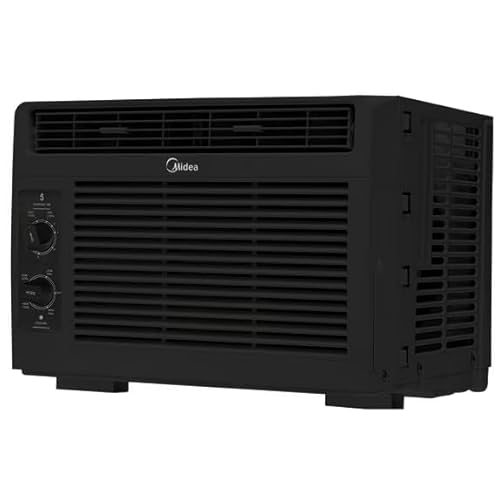
Midea 5,000 BTU Mechanical Window AC
Best for: small rooms needing basic mechanical cooling
- Cooling Capacity
- 5,000 BTU
- Coverage Area
- 150 Sq ft
- Control Type
- Mechanical
- Dimensions
- 13.2 × 16 × 12.1 inches
- Weight
- 33.1 pounds
View on Amazon: Midea 5,000 BTU Mechanical Window AC Affiliate link
This Midea unit delivers 5,000 BTU of cooling for spaces up to 150 square feet. It features a mechanical control interface with two cooling modes, two fan speeds, and seven temperature settings. The physical dimensions are 16 by 12.1 by 13.2 inches, and it weighs 33.1 pounds. It fits windows between 23 and 36 inches wide with a minimum height of 13 inches. It is a straightforward option for small rooms.
Pros
- 5,000 BTU cooling capacity
- Covers areas up to 150 square feet
- Seven temperature settings for precise control
- Two fan speeds for airflow adjustment
- Fits windows 23 to 36 inches wide
Cons
- Lower 5,000 BTU capacity compared to the 8,000 BTU competitor
- Mechanical controls lack smart app connectivity
- Smaller 150 square foot coverage area
Good fit if
- You need cooling for a small room under 150 square feet
- You prefer simple mechanical dials over digital interfaces
- You have a window opening between 23 and 36 inches wide
Skip if
- You require smart home integration or app control
- You need to cool a room larger than 150 square feet
- You want higher cooling power than 5,000 BTU provides
Verdict: Midea 5,000 BTU Mechanical Window AC is a basic cooling solution for small spaces. It fits buyers who prioritize simplicity and do not need smart features or high-capacity cooling.
Specifications side by side
| Spec | Hisense 8,000 BTU Smart Inverter Window AC | Midea 5,000 BTU Mechanical Window AC |
|---|---|---|
| Cooling Capacity | 8,000 BTU | 5,000 BTU |
| Coverage Area | 350 Sq Ft | 150 Sq ft |
| Control Type | Wi-Fi app | Mechanical |
| Compressor Type | Inverter | not stated |
| Voltage | 115 Volt | not stated |
| Features | Inverter | not stated |
| Dimensions | 20.3 × 20.5 × 14.6 inches | 13.2 × 16 × 12.1 inches |
| Weight | 52 pounds | 33.1 pounds |
| Color | White | Black |
| Model | HLAW0825TW | RMW05MWB |
| Size | not stated | 5,000 BTU |
Frequently asked questions
Which unit is better for a small bedroom?
The Midea 5,000 BTU model is the better choice for small spaces. It covers up to 150 square feet, which suits compact rooms. The Hisense unit is designed for larger areas up to 350 square feet. Using the higher capacity unit in a small room may lead to short cycling and less humidity control.
Does the Hisense air conditioner use inverter technology?
Yes, the Hisense 8,000 BTU unit features inverter technology. This allows the compressor to adjust its speed based on the cooling demand. It maintains a steady temperature more efficiently than non-inverter models. The Midea mechanical unit does not list inverter specs, relying on standard on-off cycling for cooling.
How do the physical sizes compare between these two?
The Hisense unit is larger in all dimensions. It measures 20.5 inches wide, 14.6 inches high, and 20.3 inches deep. The Midea model is more compact at 16 inches wide, 12.1 inches high, and 13.2 inches deep. You should check your window frame dimensions to ensure the smaller Midea unit fits properly.
Is smart control available on the Midea window AC?
The Midea 5,000 BTU model uses mechanical controls. It does not list smart home integration or app connectivity in its specifications. The Hisense unit is marketed as a smart inverter AC, suggesting it likely supports remote management. If you need app control, the Hisense option is the suitable choice.
What is the weight difference between the two units?
The Hisense unit weighs 52 pounds, while the Midea unit weighs 33.1 pounds. The Hisense is nearly 19 pounds heavier due to its larger frame and inverter components. The lighter Midea model may be easier to handle during installation or removal for seasonal storage.
Can I use the Hisense AC in a small room?
You can use the Hisense AC in a small room, but it is overpowered for the space. It is rated for 350 square feet. Using an 8,000 BTU unit in a 150 square foot room may cool the air too quickly without removing adequate humidity. The Midea 5,000 BTU unit is better matched for smaller areas.
Which model is quieter based on the specs?
The provided specifications do not list decibel levels for either unit. You cannot determine noise output from the given data. The Hisense uses an inverter compressor, which often runs quieter than standard compressors, but this is not confirmed in the specs. The Midea uses mechanical controls, which may involve louder cycling sounds.